Monday, January 17, 2011

Biesbosch productieland

De Brabantse Biesbosch staat bij veel mensen bekend als een ongerept moerasgebied waar de rivier nog vrij spel heeft en bevers geen boom laten staan. Het is toch zeker niet voor niets één van de twintig Nationaal Parken die Nederland rijk is? Nee, natuurlijk ga ik nu niet vertellen dat het anders is. Daarmee bedoel ik te zeggen dat ik vermoed dat het gebied dat voor het publiek ontoegankelijk is, vast onvoorstelbaar prachtig is. Na jaren zeer regelmatig in de Brabantse Biesbosch te hebben vertoefd, fantaseer ik nog steeds over hoe het er achter die dijken uit zou zien, die je op veel plekken het zicht op het echte ongerepte deel van de Biesbosch ontnemen. Nog steeds kan ik mij moeilijk voorstellen dat er in de Biesbosch niet volop Kwakken zitten, zoals ik voorheen wel dacht. Nee, de Brabantse Biesbosch die je daadwerkelijk ziet, is nog steeds de ontgonnen Biesbosch met gigantische akkerbouwpercelen die zich als een volstrekt reliëfloze lappendeken uitstrekt tussen de Nieuwe Merwede en het Steurgat.

In de meeste seizoenen vind ik deze akkerbouwpercelen niet erg interessant wat vogels betreft. Wellicht een onderwaardering, maar mijn voorkeur gaat toch uit naar de randen van de Biesbosch, zoals polder Maltha, en het nieuwe natuurontwikkelingsgebied de Noordwaard, dat recent is afgegraven en nu in verbinding staat met de rivier. In de winter verandert dat echter aanzienlijk, en kan je op deze akkers een waar vogelspektakel aanschouwen. De bietenresten op de kleiige akkers trekken ’s winters vele duizenden ganzen en honderden zwanen aan die in grote groepen komen foerageren. Het afgelopen weekend hebben Jonne en ik twee dagen achter elkaar staan genieten van het luidruchtig gakken van de ganzen en het melancholieke trompetteren van Wilde en Kleine Zwanen.

The high water level of the river Merwede has flooded its floodplains

Daaraan ging vooraf dat Jonne vrijdag een eigen telescoop heeft gekocht. Dat is wel een vreugdedansje waard en volgens mij een schitterende investering in onze relatie! Natuurlijk moest de nieuwe telescoop zaterdag meteen in het veld getest worden. Voor het eerst hoefde Jonne niet in de bittere kou of in de auto op mij te wachten als ik weer eens een groep ganzen afzocht naar halsbanden of bijzondere soorten. Voor het eerst stonden we zij aan zij met allebei een telescoop en konden we zelfs wedstrijdjes doen wie de eerste halsband in een groep ganzen gevonden had. Wedstrijdjes die overigens meestal gewonnen worden door Jonne.

Zo kon het gebeuren dat de akkers waar in de zomer productie wordt gedraaid, ook ’s winters zeer productief werden. In twee dagen vonden we samen maar liefst 18 unieke halsbanden en lazen we 2 pootringen af.  In totaal ging het om 6 Grauwe Ganzen (met blauwe en groene halsbanden), 5 Kolganzen (met zwarte en mintgroene halsbanden), 3 Toendrarietganzen (met gele halsbanden) en 6 Kleine Zwanen (4 gele halsbanden, 1 witte pootring en 1 metalen pootring). Waarschijnlijk hebben we zelfs nog halsbanden gemist in de grote dichte groepen ganzen, maar de behaalde score is voor onze doen uitzonderlijk hoog. De oorzaak laat zich raden! Alle halsbanden hebben we netjes ingevoerd op de website www.geese.org van Alterra. Het mooie van die website is dat je direct de hele levensgeschiedenis krijgt te zien van de gans die je meldt. Je krijgt een compleet overzicht te zien van waar, wanneer en door wie de vogel is geringd, en waar en wanneer de vogel in de tussentijd al eens gemeld is. Dit alles wordt vervolgens ook nog eens keurig geïllustreerd op een mooi kaartje van Google maps. De meeste ganzen die wij in het weekend zagen waren enkele dagen eerder of in december 2010 al eens gezien in de Biesbosch. Twee van de Kleine Zwanen met een halsband waren extra leuk, omdat ik die anderhalve week geleden zelf in mijn handen gehad heb tijdens een vangst in Zeeland.

Many geese and swans are now foraging on beet rests

Al met al waren zowel Jonne als ikzelf bijzonder tevreden met haar nieuwe telescoop. Volgend weekend zullen we eens zien of hij in de Krimpenerwaard net zo goed werkt als in de Biesbosch! Voorlopig zijn de eerste succesjes alvast geboekt.

Thursday, January 13, 2011

Fields of g...eese

Door de stevige dooiaanval die Nederland vorige week meemaakte, is de meeuwenpret langs de Hollandsche IJssel over zijn piek heen. Stonden er eind december nog honderden meeuwen met prachtig mooi zichtbare poten op het ijs van de Hollandsche IJssel, nu staan ze weer op de basaltblokken die alleen met laagwater droog vallen. Bovendien zijn er nu weer veel meer plekken om te gaan foerageren, dus verspreiden de meeuwen zich over het land met als gevolg dat de aantallen bij de Haastrechtse brug te Gouda wat lager zijn. Desondanks kregen we toch nog wat geringde meeuwen in beeld. De paar metaalgeringde Kokmeeuwen kenden we allemaal al van eerder deze winter, maar wel vonden we een paar nieuwe kleurringen. Zo doken er op 3 en 5 januari weer twee ‘nieuwe’ Stormmeeuwen op van Frank Majoor (dus witte ringen met een code startend met een E) en terwijl ik me stond te bedenken dat ik het zo leuk zou vinden om weer eens een gekleurringde Kokmeeuw te zien, vond ik op 7 januari een Kokmeeuw met een rode ring. Ook van een project van Frank Majoor overigens! Het was voor deze vogel na het moment van ringen in eind 2009 de eerste waarneming buiten zijn of haar schijnbaar vaste overwinteringsstek in Hilversum.


 Two Common and one Black-headed Gull with colour rings


Er mogen dan minder meeuwen zitten langs de Hollandsche IJssel, de dooi heeft ook wel een positief effect. De vele (Kol)ganzen die door het winterse weer met veel sneeuw verder zuidwaarts getrokken waren, kwamen massaal terug in de eerste week van januari. Een dag nadat er in de Krimpenerwaard in een groep Kolganzen een tweetal Roodhalsganzen was gemeld, ben ik een ‘rondje Krimpenerwaard’ gaan doen om naar deze vogels te zoeken. Het weer was niet optimaal met een nevel die het zicht beperkte tot enkele honderden meters. Ik vond het daardoor niet verrassend dat ik de Roodhalzen niet kon vinden, maar wat heb ik genoten van het schouwspel van de grootste aantallen ganzen die ik zelf ooit heb gezien in de waard. Het oostelijke deel van polder Geer en Zijde, geheel polder Schuwacht en het oostelijke deel van polder Hoek zaten werkelijk volgestouwd met Kolganzen. Ik zou normaal gesproken schrijven dat je ze zag zover het oog reikte, maar dat is in dit geval met mist niet zo heel verrassend. Tussen de vele duizenden Kolganzen zaten ook voor Krimpenerwaardse begrippen opvallend veel Brandganzen, maar de Roodhalsganzen die werkelijk overal konden zitten, waren onvindbaar. Zelfs zwarte halsbanden waren moeilijk te vinden, iets dat ik wel vaker merk bij zulke grote groepen. Uiteindelijk kreeg ik er maar één in beeld, geringd in december 2008. In een groepje Grauwe Ganzen vond ik wel nog een witte halsband met een opvallende verdikking erop. Een GPS logger! De hoekige getallen van de code van de halsband gaven nog wat afleestwijfels (E32, E2E, of toch 332?), maar coördinator van het betreffende project Berend Voslamber wist me haarfijn uit te leggen dat het toch om 332 ging, een vogel die met foto en al zelfs op de website van geese.org staat (onder ‘nieuws).

Greylag Goose with GPS logger in neck collar 

Deze halsband met GPS logger moet met een antenne worden ‘uitgelezen’. Dat wil zeggen dat het apparaatje gegevens opslaat over waar de vogel zich bevindt en op afstand kunnen die gegevens opgevangen (uitgelezen) worden. “Er zullen binnenkort wel mensen van Alterra heen gaan”, had Berend Voslamber gezegd. Toen ik afgelopen zondag samen met Jonne weer in de buurt ganzen aan het kijken was, reed er op een moment een auto langs over een polderweggetje met een bordje ‘Alterra’ op het dashboard. Dat kon niet missen dacht ik, en toen ik ze aansprak vertelden ze me dat ze inderdaad op zoek waren naar Grauwe Gans 332. Helaas had ik de vogel die dag nog niet gezien en zij zelf hadden de vogel ook nog niet teruggevonden. Ik heb de rest van de middag hard mijn best gedaan om 332 weer te vinden, maar verder dan twee Kolganzen met een zwarte halsband kwam ik niet. Toch is het erg leuk om te zien dat er wel degelijk actie wordt ondernomen als je een waarneming meldt!

Nu de kerstvakantie weer echt voorbij is en de dagen nog steeds kort zijn (dus je met donker van huis gaat en in het donker weer thuis komt), zal het wel weer wat rustiger worden met ringaflezingen. Toch is er ook een positieve ontwikkeling gaande: Jonne gaat een eigen telescoop kopen! Dat betekent dat we voortaan niet meer me z’n tweeën één telescoop hoeven te gebruiken en we samen kunnen zoeken naar ringen, halsbanden en andere leuke dingen. Ik ben benieuwd wat die dubbele inzet allemaal gaat opleveren!

English summary - The ice on the river has gone, so our favorite ring reading spot for gulls is getting less productive. Instead of standing nicely visible on the ice, the gulls are now standing on the rocks again and only with low tide, harder to see and in lower numbers. Nonetheless we did find some metal ringed Black-headed Gulls last week that we knew from earlier this winter and a few 'new' colour ringed gulls: 2 Common and 1 Black-headed Gull, all from Frank Majoor's project. The thaw also has an advantage. Now that the snow has gone lots of geese have returned from further south and several black neck collars can be found again in the flocks of thousands of Greated White-fronted Geese. On the 7th I also found a Greylag Goose with a white neck collar which also contained a GPS logger. Last Sunday I met the people who were trying to retrieve the data from the logger, but unfortunately they couldn't find the bird back, and neither could I. However, it's great to see that it really helps people when you report your sightings!

Thursday, December 30, 2010

Toptijd ringen aflezen

Let’s continue this blog in Dutch, an English summary can be found below… Winter, sneeuw en ijs zijn perfecte condities om meeuwenringen af te lezen. Omdat het nu begint te dooien, waren de afgelopen dagen hét moment om ringen te zoeken. Dat hebben we in de Krimpenerwaard dus ook volop gedaan, niet alleen ik maar ook enkele anderen. Vanaf eerste kerstdag, dus binnen een week, hebben we bij elkaar in de Krimpenerwaard maar liefst 26 ringen afgelezen, een absoluut record!

De toplocatie was weer de Hollandsche IJssel bij de Haastrechtse brug te Gouda. Rond kerst lag hier nog veel ijs waarop veel meeuwen stonden met prachtig zichtbare poten. Ook nu het ijs weg is, zitten er nog veel meeuwen maar het is duidelijk dat het aflezen weer wat lastiger wordt. Op deze plek lazen we 13 meeuwenringen af, verdeeld over 8 Stormmeeuwen, 4 Kokmeeuwen en 1 Zilvermeeuw. De verste vogel, op basis van het ringstation dat vermeld staat op de ring, was een Kokmeeuw uit Litouwen. Het leukst waren echter misschien wel de gekleurringde Stormmeeuwen van het project van Frank Majoor. Nadat ik hier al weken naar aan het uitkijken was, vond ik op 27 december eindelijk witte kleurringen en meteen 3 tegelijk. Tot mijn verbazing bleken het niet alledrie vogels te zijn die de afgelopen door Frank geringd zijn, maar 2 van de 3 waren al de vorige winter geringd. Een dag later vonden Johannes en ik twee van de vogels terug, maar ook nog een nieuwe die Johannes vorig jaar op dezelfde plek ook had afgelezen. Al met al kon ik de afgelopen week bijna elke avond tevreden nieuwe ringaflezingen invoeren in mijn overzichtje.


 Common Gulls from the project of Frank Majoor (www.frankmajoor.nl)

De leukste soort waarvan een ring kon worden afgelezen, was een Pontische Meeuw met een groene kleurring. Johannes vond deze vogel een stukje verder op de Hollandsche IJssel in Gouda. De vogel bleek uit Polen te komen. Pontische Meeuwen zijn behoorlijk zeldzaam in de Krimpenerwaard en om dan ook nog eens extra informatie te kunnen krijgen van een individuele vogel die hier opduikt, is bijzonder interessant. Het bleef voorlopig bij een eenmalige waarneming van deze vogel, maar wie weet duikt hij binnenkort weer op.

Verder werden er wat meeuwen afgelezen langs de Hollandsche IJssel tussen Gouderak en Ouderkerk a/d IJssel, en bij Schoonhoven langs de Lek. Er werden twee Kleine Zwanen gemeld, één met een halsband (uit Nederland) en één met een pootring (uit het broedgebied in Rusland). Uiteindelijk lazen we ook nog halsbanden van drie Kolganzen (2x zwart en 1x groen) en een Grauwe Gans (groen) af. De meeste ganzen in de Krimpenerwaard zitten momenteel in polder Zuidbroek ten westen van Bergambacht (samen met Kleine Zwanen) en ten noorden van de provinciale weg tussen Bergambacht en Schoonhoven ongetwijfeld zijn er tussen deze ganzen nog meer halsbanden te ontdekken…

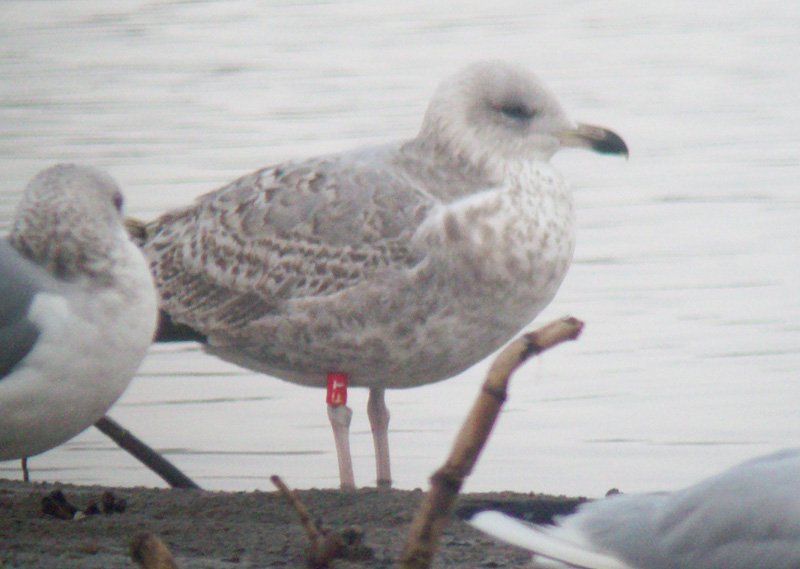
2CY Herring Gull along the Hollandsche IJssel

English summary – The winter cold of the past week provided optimal conditions for ring reading. Within a week we read no less than 26 rings in the Krimpenerwaard, a new record! On our favourite spot for gull rings we read rings of 8 Common Gulls, 4 Black-headed Gulls (1 from Lithuania) and 1 Herring Gull. We were very happy with the white colour rings of Common Gulls from a project of Frank Majoor (www.frankmajoor.nl), of which we saw 5 individuals. Another very nice ring reading was of a Caspian Gull from Poland. It is very interesting to get more information of a bird so rare in the Krimpenerwaard. Other readings were from various species such as Bewick’s Swan, Greylag Goose and White-fronted Goose. Hopefully we will remain just as successful when the ice has gone next week!

Thursday, December 23, 2010

Christmas twitch

Was this already the regional Christmas twitch of the year? For many birders in the Krimpenerwaard it was a new species on the regional list (as it was for me), the Eider, common along the coast but quite rare inland. Yesterday morning the bird was first reported on the Hollandsche IJssel near Gouderak but I was at work and unable to leave (questionable if I would if I could anyway for an Eider…). However, this morning I was able to squeeze out for a moment and after a 15 minute bicycle ride the bird was ‘in the pocket’! Number 213 on my very slowly growing regional species list. The bird, a 1st winter male, was swimming on the river near a small water outlet just west of Gouderak. Although it didn’t seem to be in very good condition I did see it diving once and when it came back on the surface I saw it swallowing, so apparently it can at least find some food. The bird was not wary and rather approachable so I wanted to make some video shots, but the battery of my camcorder was dead. Not to worry, I had a spare one with me, but that one also turned out to be dead. So my apologies to you, no moving images of the Eider today!

Poor record shot of the Eider

Where it all happens... A Ferruginous Duck was also seen here two weeks ago!

Although it was the rarest one for this region, the Eider was not the only interesting duck on the Hollandsche IJssel. All small waters are still covered with ice and many ducks have moved to the river. There are especially many Tufted Ducks everywhere, good numbers of Gadwall and several Common Pochards. On two spots I also found a Goosander and on the river in Gouda I saw a beautiful male Smew. These winter conditions can be really nice for birdwatching! Unfortunately many geese and ducks also choose to fly further south (see my last blog ‘showrush’) and reach the north of France. Messages just came in about a true massacre going on there. Weakened by the flight and hunger they are awaited by local hunters who have never seen such numbers of waterfowl. I don’t usually complain such things, but I think this is a real shame and quite disrespectful. Attempts are now made to make the local government prohibit or at least limit the hunting on these birds.


Monday, December 20, 2010

Snowrush

Like most of Europe, the Netherlands are in a firm grip of Winter. Last week large parts of the country have had a lot of snowfall up to several decimetres. For many birds – especially those that forage on the ground – this is quite a problem and hunger drives them to go further south. When snowfall causes a massive migration event we call that a ‘snowrush’. Most prominently are the geese, especially White-fronted, of which many thousands could be seen on any place in the Netherlands over the last few days, all migrating in south-western direction. They are followed by large flocks of Skylarks, another species typical for a snowrush. The increasing numbers of Barnacle Geese are an indication that the enduring snow cover is indeed a problem. Surely these birds don’t really enjoy the weather, but for birdwatchers a snowrush is a very enjoyable phenomenon.

Not all hungry birds decide to leave the snow covered northwest of Europe. Gulls for instance are more opportunistic in finding food and gather on places with open water or in towns and cities where people (like me!) feed them with bread crumbs. Of course my efforts are not entirely out of a deeper sense of morality towards living creatures. Feeding bread crumbs also gets you closer to the ringed individuals… On the ice of one of the ponds in the village of Werkendam (where Jonne lives) two metal ringed Black-headed Gulls were among the large flock that was attracted by my bread crumbs, one Belgian bird and one Polish, my very first from this country! Two days before, on last Friday, I also found a colour-ringed Common Gull at my favourite ring reading spot along the Hollandsche IJssel near Gouda. A green ring with a white code, a colour combination I had never seen before on this species. The metal ring on the other leg read FINLAND so it wasn’t hard to find out where this bird came from. As a matter of fact the ringer replied to my report with the information that he had ringed the bird in July 2006 in western Finland and never had a sighting of this bird before! A very valuable sighting! I’m curious if I will see this bird again…


Very close to this ring reading spot of mine there is another city pond (in Gouda) where I saw something I had never seen before. On the edge of the ice along the last bit of open water there was not only a Grey Heron, but there were also two Great Egrets standing there, staring in the water. Simply next to a road in a city! Normally you see these bird in the open polders where they are often quite shy, but these birds were just standing there… I couldn’t resist making a few record shots. Very funny to hear that even some of the local people had noticed these odd birds (thinking they were something like White Storks)! Hopefully these gracious birds survive a few more cold days before the thaw comes in again.


Friday, December 10, 2010

Many new rings to read

Winter is not only the perfect season for reading bird rings, but also for catching some of the species that are often colour-ringed. This year is no exception. Over the past week hundreds of gulls were caught and ringed with metal and colour-rings by gull researcher Frank Majoor and colleagues and today a number of Tundra Bean Geese (first of this season in NL?) were caught and ringed together with a few Bewick’s and Whooper Swans. Below a short report to get you all focused again!

We hadn’t even been standing on our spot for a full hour yet but I could already hardly feel my toes. The thin soles of my rubber boots didn’t give a lot of isolation from the cold slippery ice on the asphalt. It was another cold morning in the Wieringermeer. We kept an eye on the white and brown spots on a distant sugar beet field that were swans and geese. Some Tree Sparrows and Skylarks called when they flew over our heads. We could have been standing there waiting for hours and hours, but fortunately our cannon-detonator soon told us over the radio to get ready for some action. After a 3 to 1 countdown we first saw swans and geese taking off and a large net falling over a part of the flock. Only a second or two later we heard the bang. Canon-netting, shooting a net over a flock of birds, is just about the only way to catch adult geese and swans. After a quick and smooth collection of the birds we set up our little ringing station in one of the local farms’ sheds. For several scientific purposes the birds were then ringed, weighed and measured. The catch was quite successful and we were able to ring the first large batch of 25 Tundra Bean Geese of the season.

Tundra Bean Goose in the loving hands of Wim Tijsen 

In the flock of geese we had also caught 3 Bewick’s and 6 Whooper Swans. Besides a metal and a colour ring on the legs, the geese and the Bewick’s Swans also got a yellow neck collar with a black code which makes it a lot easier to identify them in the field. Some special attention was paid to the shape of the bill and head of the bean geese because of the continuing discussion about the identification of Tundra and Taiga Bean Goose. Surely these birds were all Tundra, but still we thought it’d be useful to take photos of all the heads. After all birds were ringed and all measurements were taken the geese were released at the catch site and the swans, following standard procedure, a few hundred meters further away, on the IJsselmeer. All birds appeared in fine condition and happy to be free again, so now it’s waiting for resightings! All resightings can be reported on the website www.geese.org.

 Famous goose and swan catcher Kees Oosterbeek at work

Then a few words about the ringed gulls. I received word that gull researcher Frank Majoor and his crew have caught and ringed a large amount of gulls (Black-headed, Common and Herring) in the Netherlands last week. For example on the 3rd of December >250 Black-headed Gulls and almost 200 Common Gulls were caught in Zoetermeer. All of the latter species got a white colour ring beside a metal one. The next day, on the 4th of December, about 400 Black-headed Gulls, 125 Common Gulls and 90 Herring Gulls were caught in the city of Groningen. Again all Common Gulls were also colour ringed. The grand total of caught and ringed gulls last week is 1310 Black-headed and 369 Common Gulls. This means that we’ve got a lot of ring reading to do again! More information about this project can be found on the website www.frankmajoor.nl. Frank Majoor is also the one you should contact when you’ve read a white colour ring on a gull.

Tuesday, December 7, 2010

Ring reading excursion in the snow

Last Saturday’s birding tour was supposed to be the ‘crown’ on my attempts to get more people reading bird rings in my area, the Krimpenerwaard. For those who are completely new to the phenomenon of ringing (or banding) birds: for scientific purposes birds can be marked with a small metal or coloured plastic ring around the leg. This ring holds a unique inscription so the bird can be individually identified in the field. Rings of very small birds are too small to be read with a telescope and these birds have to be recaptured, but rings of gulls for instance are big enough to be read with a telescope. Although it’s not exactly easy, some birdwatchers think its really exciting to read bird rings in the field. Admitted, I’m one of them.

But more than an exciting hobby, the reading of rings contributes to our knowledge of bird behaviour and wellbeing. The number of questions that can be answered by analysing the data collected by ringing projects is almost unlimited, if carried out correctly of course. But before you can answer any questions there has to be something to analyse. Gulls wintering in the Krimpenerwaard, where do they come from? Geese in the polder, how long do they stay and do they come back to the same spot each year? To be able to answer such questions, people have to trace down ringed birds and read the rings.

Since I started to search for ringed birds more regularly last year there are just about 2 persons in the Krimpenerwaard who do this on a regular basis. Add to that a handful of people who occasionally report a ringed bird and that’s it for this region. With an active bird club in the Krimpenerwaard with more than 600 members, I thought it should be possible to make more people enthusiastic for reading bird rings. After a few articles in the club’s magazine I decided to give a lecture about how to read bird rings and organise an excursion to practice in the field. The lecture was organized quite well, but beside Jonne who came for mental support, there were only 6 participants. I keep telling myself it must have been the weather conditions!

So last Saturday there was the tour and I was sure more people would be interested in a field excursion than a boring lecture. Unfortunately the weather forecast was dreadful: loads of snow on the morning. Nonetheless I was slightly disappointed when it turned out that as much as 3 die-hard birdwatchers showed up at the meeting point. So this is how sensitive people are to exciting stories about reading and reporting bird rings!

Of course all those people who did NOT come don’t know what they’ve been missing. Let’s just forget that we had only 1,5 hours before we found ourselves in a true blizzard, but before that we really did have some success. At one of my favourite spots for ring reading (Haastrechtse brug, Gouda) we found one ringed Common Gull in a mixed flock of about 200 Common and Black-headed Gulls. The bird was wearing a white colour-ring (EA90) on the left leg and a metal one on the right. Colour-rings are generally very easy to read and it took us a few seconds to read it. Luckily, because the bird quickly decided to go sit down on the ice to avoid heat loss via the bare legs. This was a new sighting for this spot (the bird wasn’t seen here before) and my day was a success after all!

Poor record shot of the ringed Common Gull just before it went sitting on the ice...

Because of the strong, cold wind we didn’t stay too long and we quickly went to Schoonhoven where I knew two possible spots for ring reading. At the first spot, near the ferry across the river Lek, many gulls were attracted by our bread crumbs and after a few minutes we found a metal ringed Common and Black-headed Gull. However these were not the most cooperative birds of the flock and they disappeared as soon as they appeared, leaving us with only a part of the inscription. With a part of the inscription you can’t be sure which individual bird you’re dealing with, so this didn’t help us a lot. At the other spot in Schoonhoven, the pond in the park, there was a flock of Black-headed Gulls, but none of the birds was ringed. Unlike the Friday before, when I found two metal ringed Common Gulls here. I had then been able to read one complete code, and surprisingly this was a bird from Finland (it said ‘ZOOLOGICAL MUSEUM HELSINKI FINLAND’). A nice result after all!

While driving to our last spot, the snow came and didn’t stop. This meant that I soon lost 2 of my participants and with only one left I arrived in Krimpen aan den IJssel where we also visited a pond in the park. The snow didn’t help a lot but after a little while we found one Black-headed Gull with a metal ring that I had also read the day before. Another Finnish bird! What a fantastic idea that the birds that we are feeding bread crumbs in our cities in winter are birds that have travelled so far to get here! Only by reading rings we can reveal this information… Have I made my point?

This weekend got me three ‘new’ birds in the Krimpenerwaard, something that doesn’t happen each week so I’d say this is a very satisfactory result, despite the weather. I still keep hoping that this kind of results will at some point open more people’s eyes so more rings will be read in the Krimpenerwaard and more interesting data will be collected. For more information about bird rings in the Krimpenerwaard you can visit the website of the regional bird club, the Natuur- en Vogelwerkgroep Krimpenerwaard: www.nvwk.nl.